
Commercial Security Fence Specifications for Different Site Needs
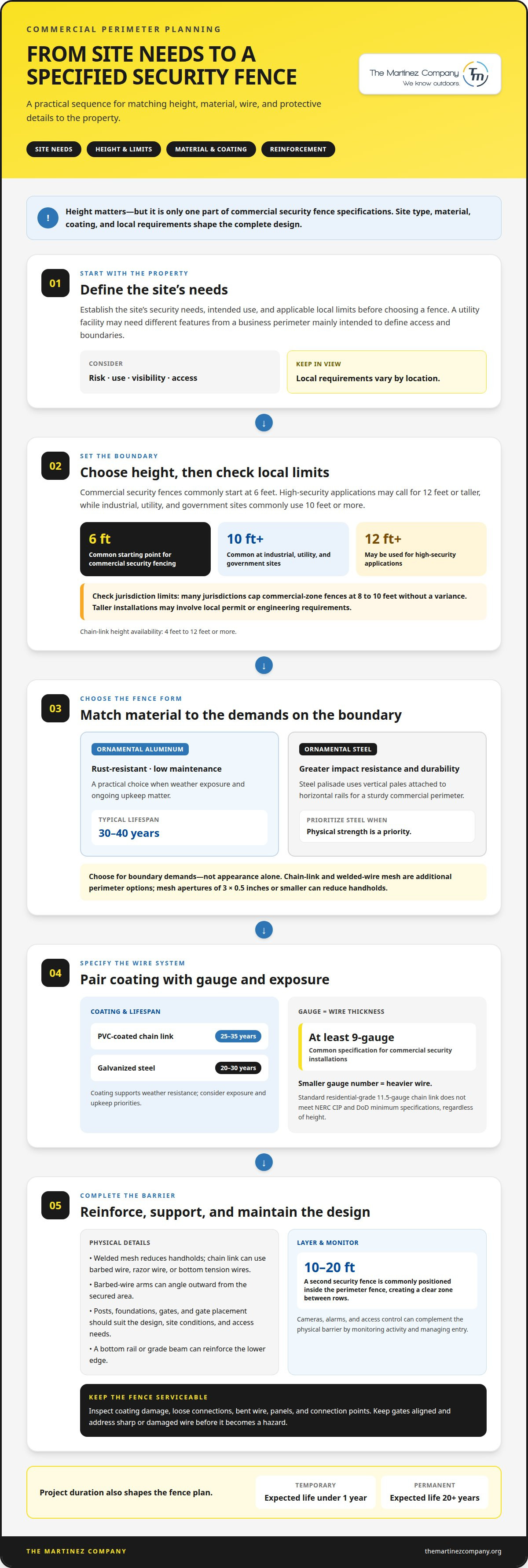
A taller fence isn’t automatically the right security fence. Commercial security fence specifications often start with a six-foot fence, while high-security applications may call for 12 feet or taller. The right height depends on the site’s security needs and the requirements that apply to its location.
Height matters, but it is only one part of commercial security fence specifications. Site type, fence material, and coating also shape the design. A utility facility may need different features from a business perimeter intended mainly to define access and boundaries.
We’ll compare the key choices and explain how they work together, so you can understand what makes a fence suitable for your site before moving from requirements to a finished structure.
Table of Contents
What Height Should a Commercial Security Fence Be?
Commercial security fence specifications begin with the site’s risk, intended use, and local limits. Across the United States, commercial fences commonly start at 6 feet and can reach 12 feet or taller for high-security applications.
Commercial Height Recommendations
A suitable fence height balances deterrence, visibility, and the requirements that apply to the property. High-security properties often use fences at least six feet tall; industrial, utility, and government sites commonly use 10 feet or more. Local height limits vary, and many jurisdictions cap commercial-zone fences at 8 to 10 feet without a variance. Installation costs depend on the site, materials, height, and project scope; pricing is provided after a quote request.
Height Choices Across Fence Styles
Fence style affects how height works with visibility, boundary definition, and access. Commercial chain-link fencing is available from 4 feet to 12 feet or more, while ornamental aluminum and steel provide a more finished perimeter. Specify posts, foundations, and gates to support the fence design and site conditions; gate placement and construction should align with the required access and security function. Taller installations may involve local permit or engineering requirements.
Anti-Climb Features and Fence Height
Anti-climb features can strengthen a fence’s deterrent value, but they do not replace appropriate height. Welded mesh has small apertures that reduce handholds, while chain link can be reinforced with barbed wire, razor wire, or bottom tension wires. Barbed-wire arms can angle outward from the secured area. Cameras, alarms, and access control can complement a physical barrier by monitoring activity and managing entry.
Chain-Link Gauge and Height
Chain-link gauge describes wire thickness, not fence height; a smaller gauge number means heavier wire. Commercial security installations commonly specify at least 9-gauge fabric, while standard residential-grade 11.5-gauge chain link doesn’t meet NERC CIP and DoD minimum specifications, regardless of height. Consider gauge alongside height and reinforcement: taller fabric still needs appropriate resistance to cutting and climbing. A bottom rail or grade beam can reinforce the lower edge.
Ornamental aluminum versus steel fencing
Ornamental fencing defines a perimeter while maintaining an open, finished appearance. For a retail property, choosing between aluminum and steel means weighing maintenance, rust resistance, and impact resistance.
Ornamental aluminum is rust-resistant and low-maintenance, making it a practical option where exposure to weather and ongoing upkeep matter. Its typical lifespan is 30-40 years. Aluminum can suit commercial properties that want a lasting boundary without the heavier impact resistance associated with steel.
Ornamental steel offers greater impact resistance and durability than ornamental aluminum. Steel palisade fencing uses vertical pales, or pickets, attached to horizontal rails to create a sturdy commercial perimeter. Its structured, visible design can suit sites where physical strength is a priority. Choose the material for the demands on the boundary, not appearance alone.
For sites needing an additional layer, a second security fence is commonly positioned 10 to 20 feet inside the perimeter fence. The space between rows can serve as a clear zone, making the inner barrier distinct from the outer boundary. A barbed-wire top may be considered where the site’s security design calls for it, while local requirements and the purpose of each fence guide the overall layout.
Temporary and permanent fencing serve different project needs. Temporary installations generally have an expected life of less than 1 year, while permanent fence installations generally have an expected life of 20 or more years. That distinction matters when planning a lasting commercial boundary versus short-term site separation. For a permanent perimeter, commercial fence construction can bring the selected material and site layout together as one finished structure.
Galvanized and PVC chain-link coatings
Galvanized or PVC-coated chain link can provide weather resistance around commercial perimeters. The right choice depends on exposure, maintenance priorities, and the site’s security needs.
Chain-link fencing uses interlocking steel wires in a diamond pattern, while welded-wire mesh joins vertical and horizontal wires. Mesh apertures of 3 by 0.5 inches or smaller can reduce handholds. Both materials can form part of perimeter security, with coating, wire gauge, and installation details shaping the finished barrier.
Polymer-Coated Chain-Link Systems
Polymer-coated chain link adds a PVC layer over steel wire, helping protect the fence from weather. Vinyl-coated chain link has a typical lifespan of 25-35 years, compared with 20-30 years for galvanized steel. That difference can help commercial properties weigh coating choice against expected upkeep. Cameras can monitor the perimeter, while barbed wire may provide an additional physical deterrent where the design calls for it.
Gauge matters on industrial sites: a smaller gauge number indicates heavier wire, affecting the fabric’s physical strength. Consider gauge alongside coating. Coating supports weather resistance, while wire thickness helps determine resistance to damage. Neither replaces a suitable layout or secure installation.
Maintenance, Corrosion, and Safety Risks
Ongoing maintenance, corrosion, and safety risks can weaken a fence or create hazards. Inspect for coating damage, loose connections, and bent wire; exposed steel may be more vulnerable to corrosion. Keep gates aligned with their openings, and address sharp or damaged wire before it becomes a hazard. If barbed wire is used, its placement should suit the site’s security design and access needs.
For example, a commercial property exposed to harsh weather may prioritize coated wire and regular visual inspections. A site with welded mesh can also include panels and connection points in routine upkeep. Match the material, coating, and maintenance plan to conditions around the perimeter.
Fence requirements by commercial site type
Commercial security fence specifications should reflect what a facility protects, how people enter, and the risks around the property. A utility substation, retail site, and industrial facility have different priorities, so one perimeter design will not suit every operation.
For covered utility substations, NERC CIP-006-6 requires a minimum 6-foot physical barrier and limits gaps to 96 square inches. Those requirements make the fence fabric, openings, and ground-level details central to the design. At facilities subject to this standard, access control and monitoring support the barrier, but don’t replace it.
Industrial facilities may prioritize resistance to climbing, cutting, or vehicle access, while retail properties may need clear entry points and visibility around customer areas. Government buildings can have distinct security and screening needs. Local building regulations may affect permitted fence types, materials, and lighting, so the site’s location helps shape the final specification.
For CFATS Tier 1 and Tier 2 facilities, physical barriers and detection systems are complementary components, not substitutes. Cameras and alarms can help monitor activity, while access control manages authorized entry through gates. A clear design assigns each element a role: the fence defines the boundary, gates control passage, and monitoring helps identify activity at vulnerable points.
Ground-level protection matters too. The bottom of a security fence should sit no more than 2 inches above grade, limiting space beneath the fabric. Where the site needs stronger resistance to the mesh being forced upward, burying chain-link fabric 12 inches or more can help. These details reduce opportunities at the fence’s weakest edge.
Start with the facility’s security function, then align fence construction, gates, and monitoring with that purpose. For a commercial property that needs its perimeter built into a coordinated project, plan commercial fence installation as part of its broader site requirements.
The Martinez Company: Commercial Contracting
The Martinez Company provides commercial contracting and fence installation for businesses planning a secure, durable perimeter. The team can take your project from site requirements and material choices through to completed fence installation. The design can account for the property’s intended use, access points, and selected fencing style, bringing practical function and a finished appearance together.
Fence planning is part of the broader construction picture for a commercial property. The Martinez Company can integrate the specified fence into the project’s overall site work, with attention to how the finished structure fits its surroundings.
Move from fence requirements to a build-ready plan
A secure perimeter starts with decisions that suit the property’s purpose and continue to work as the site changes. Use your commercial security fence specifications as a foundation for planning how the boundary should function within the wider project. A clear plan connects the fence to the site layout, daily operations, and the experience you want people to have when they arrive.
The Martinez Company offers Commercial Contracting, Residential Contracting, and Outdoor Living Spaces. If fencing is part of a larger property improvement, these services can support related construction goals alongside the perimeter. Share your plans and what the finished space needs to accomplish to take the next step.
Contact The Martinez Company to discuss your project and take the next step with confidence.
Frequently Asked Questions
Which Type of Commercial Fence Is Most Cost-Effective for Large Properties?
No single fence type is the most cost-effective choice for every large property. Chain link can be practical for extensive boundaries, but overall value also depends on coating, terrain, gate count, access needs, and upkeep. For example, a warehouse with long, straightforward boundaries may prioritize continuity, while a retail property may place more weight on appearance and visibility.
What are standard specifications for commercial security fencing?
A useful specification records the fence style, wire or panel construction, coating, height, gate locations, post and foundation design, ground clearance, and any reinforcement. It should also describe access, visibility, and maintenance requirements. List each gate separately from continuous fence runs so that openings and boundary sections are clearly defined in the project scope.
What fence heights and mesh sizes are used for commercial security?
Commercial layouts match fence height to site risk and mesh to visibility and climbing resistance; there isn’t one combination for every property. For facilities needing clear surveillance sight lines, 356 and 358 fencing are options. Smaller mesh apertures can reduce footholds, while the selected height must also suit property boundaries, site operations, and applicable local constraints.
What are the differences between chain-link, welded wire, and palisade security fencing?
These styles differ in construction and in the trade-offs they create across a site. Chain link can cover extensive boundaries; welded wire offers panels with tighter openings; steel palisade creates a strong, visible perimeter. Compare corners, slopes, gate connections, sight lines, and repair needs across the actual layout rather than choosing by material name alone.
What anti-climb and anti-cut features can be added to security fencing?
Options include three or six strands of barbed wire, bottom tension wires, and 7-gauge coil spring wire installed in place of a top rail. Choose these features as part of a coordinated design, not as a substitute for sound fence fabric, posts, and gates. The top-edge treatment should fit the site’s access needs, visibility, and monitoring approach.
What U.S. building codes and local regulations apply to commercial security fences?
Applicable rules vary by jurisdiction and property. Building and property-line considerations can affect commercial fence planning. Local building regulations may also address permitted fence types, materials, and lighting. Review height, placement, gate openings, and surveillance equipment as separate items, since a rule affecting one feature does not automatically settle the others.
Comments